
What Is Wholesale Real Estate? A Beginner's Guide
Jun 23, 2026

Written by
Alex Martinez — Founder & CEO, Real Estate Skills. Has wholesaled and flipped houses for over a decade, personally acquiring 33+ residential investment properties.
Reviewed by
Ryan Zomorodi — Co-Founder & COO, Real Estate Skills. Reviewed and verified the legal points, valuation method, and definitions in this guide before publication.
Publication history: Originally published July 26, 2022. Updated June 2026 with a clearer definition, current assignment-fee figures, updated state-by-state legality guidance, a wholesaling-vs-flipping breakdown, an interactive ARV & MAO calculator, and an expanded FAQ. Legal points and definitions verified by Ryan Zomorodi, Co-Founder & COO of Real Estate Skills.
Wholesale real estate is a strategy where you put a distressed property under contract with a seller, then sell that contract to a cash buyer for a fee — typically $5,000 to $20,000+ — without ever buying the property yourself. You’re not flipping the house or becoming a landlord; you’re getting paid to connect a motivated seller with an investor who wants the deal, and the difference between your contract price and what the buyer pays is your profit.
If you’re looking for a beginner-friendly way into real estate investing without a large amount of capital, wholesaling is where many people start. You’ve probably heard the term, but maybe you’re still not sure what it actually means, how the money changes hands, or whether it’s even legitimate. This guide answers all of that in plain English.
Here’s the simplest way to think about it: a wholesaler finds a discounted property, locks up the right to buy it with a contract, and then sells that contract to someone else who wants the deal. You never own the house. You get paid for finding the opportunity and putting the pieces together — and you can do it with very little money at risk, which is exactly why so many people begin their real estate careers here.
That low barrier to entry is the appeal, but it isn’t free money. Like any real estate strategy, wholesaling rewards attention to detail and a tolerance for deals that fall apart before one finally closes. The good news is that the core skills — finding undervalued properties and knowing what they’re worth — are learnable, and they carry over to nearly everything else you might do in real estate later. If you want the broader picture first, our free beginner’s guide to real estate investing lays out how the whole landscape fits together.
What Is Wholesale Real Estate?
Wholesale real estate is an investment strategy where you put a distressed property under contract with a seller, gaining an equitable interest, and then assign that contract to a cash buyer for a fee. You never take ownership of the property. Your profit is the difference between your contract price and what the buyer pays, called the assignment fee.
In plain terms, the wholesaler is the middleman. You find a property that needs work, agree on a price with the seller, and sign a purchase contract. That contract gives you a legal, recognized interest in the property — an equitable interest — without making you the owner. Then you find an investor who wants the deal and transfer your contract to them for a fee, known as the assignment fee.
Here’s the part that makes it work, and the part beginners most often miss: until you assign the contract, you are the buyer. When you sign the purchase agreement, the law treats you as the person buying that house, with a real obligation to perform and a real interest in the property. That interest is exactly what you’re selling when you assign. So you go in with genuine intent to buy — and because you never actually close on it yourself, you carry none of the renovation, financing, or ownership risk that a flipper or landlord takes on.
It’s widely considered one of the best ways to break into real estate investing because of its low capital requirements and limited risk. But it’s not effortless. Much like any business, wholesaling rewards due diligence and a high tolerance for failure — you’ll face contract rejections, unanswered calls, and deals that collapse at the last minute. It’s not the failures that define you; it’s how you respond to them.
💡 Quick Example: How A Wholesale Deal Works
- You find a distressed property and sign a contract to buy it for $180,000.
- You bring the deal to a cash buyer — usually a fix-and-flipper — who agrees to take it.
- You assign your contract to that buyer for $200,000.
- The buyer closes directly with the seller, who gets their $180,000.
- You collect the $20,000 difference as your assignment fee — without ever owning the house.
Master that simple flow and you understand wholesaling. The rest of this guide breaks down how the deal actually works step by step, whether it’s legal, how it compares to flipping, and how wholesalers figure out what to offer.
How Does Wholesale Real Estate Work?
A wholesale deal works in five steps: find a distressed property, put it under contract at a price low enough to leave room for profit, find a cash buyer, assign the contract to that buyer for a fee, and close. You control the right to buy the property through the contract — and you sell that right rather than the house itself.
Each step has a clear job. Here’s what actually happens in a wholesale deal, from finding the property to getting paid.
1. Find a distressed property. You’re looking for something dated or distressed that a typical homebuyer would pass over but an investor would take on — a property where the seller is motivated to move quickly. These are the deals that make sense to wholesale, because there’s room between what the seller will accept and what the property is worth fixed up.
2. Put it under contract. You agree on a price with the seller and sign a purchase contract. That contract is what gives you legal control of the deal: the seller can’t sell to anyone else while it’s in effect, and — this is the part that makes wholesaling possible — the contract includes language allowing you to assign it to someone else.
3. Find a cash buyer. This is usually a cash buyer — most often a fix-and-flipper who buys distressed houses with cash, renovates them, and resells them. These are the people who actually want the deal you’ve locked up, and lining a few of them up is central to the business.
4. Assign the contract. When you’ve got a buyer, you assign the contract to them — transferring your right to buy the property over to them — in exchange for your fee. They step into your shoes as the buyer on the deal.
5. Close and get paid. The buyer closes on the property, the seller gets the price they agreed to, and you collect your wholesale fee at closing — without ever having to buy, fix, or own anything.
The cash buyer in step three is the key relationship. They’re typically a professional investor doing multiple deals, so when you bring them a property at the right number, you’re handing them something they already want. In practice, your profit comes down to two things: getting the property under contract at a low enough price, and knowing what an investor will actually pay for it. That’s why understanding property values matters so much in wholesaling — something we’ll cover further down.
That’s the concept at a high level. The actual execution — how to find distressed properties, talk to agents and sellers, run the numbers, and handle the paperwork — is its own detailed process. Our step-by-step guide to wholesaling real estate walks through all of it, and our wholesale real estate contract guide covers exactly how to fill out and use the agreements involved.
Is Wholesale Real Estate Legal?
Yes, wholesale real estate is legal in all 50 states. What you’re selling is your contractual right to buy a property — not the property itself — which is why it generally doesn’t require a real estate license. That said, a growing number of states have passed rules regulating how wholesalers operate, and a few now require a license for repeat wholesaling.
This section explains general practices, not legal advice. Wholesaling laws vary by state and change quickly — always confirm current requirements with a licensed real estate attorney in your market before doing a deal.
Let’s clear this up, because it’s the question that keeps people from ever starting. Wholesaling is legal. What you’re selling is your equitable interest in a contract — a real, recognized legal interest you hold the moment you sign a purchase agreement — not real estate brokerage services. That’s why it generally doesn’t require a license. How you structure, disclose, and market a deal matters, though, and it matters more in some states than others.
Is Wholesaling Real Estate a Scam?
Wholesaling has a reputation problem in some circles, and it’s worth addressing directly. The strategy itself is legitimate and long-established — investors have assigned purchase contracts for decades. What gives it a bad name is how a minority of people practice it: marketing properties they don’t actually control, misleading distressed homeowners about what their home is worth, or hiding the fact that they intend to assign the contract rather than buy. Done honestly — with a real contract, clear disclosure to the seller, and a genuine ability to close — wholesaling is a normal real estate transaction. Done deceptively, it’s where the complaints, and the new regulations, come from.
The Laws Are Changing: What to Know in 2026
The regulatory direction is the thing to understand, more than any single rule. In recent years, several states have added disclosure requirements, registration rules, or licensing mandates, generally aimed at protecting homeowners in distress. A few concrete examples show the range:
- In North Carolina, House Bill 797 took effect on October 1, 2025, reclassifying residential wholesaling as real estate brokerage activity that requires a broker license, and giving homeowners a non-waivable 30-day right to cancel the contract.
- Illinois limits unlicensed wholesalers to a single transaction in any 12-month period — do more than one as a pattern of business, and the state treats you as a broker who needs a license.
- Oklahoma now requires a license to publicly market a wholesale deal, and recent updates brought double closings under the same rules.
- In 2025, states including Connecticut, Maryland, and Tennessee enacted new disclosure or registration requirements for wholesalers.
The takeaway isn’t to memorize any one of these — it’s that the rules vary widely and change quickly. The single most important step before you wholesale anywhere is to confirm the current law in your specific state, ideally with a local real estate attorney. A practice that’s perfectly fine in one state may require a license, a written disclosure, or a different deal structure in the one next door.
How to Wholesale Real Estate Legally in ANY State (+FREE CONTRACTS)!
A breakdown of how to wholesale legally in any state, including attorney-informed strategies for staying compliant where the rules are stricter.

📍 Check Your State’s Rules First
Several states added or tightened wholesaling rules in 2025–2026. This is current as of 2026 and changes fast, so confirm your state’s requirements before you sign anything:
- North Carolina — House Bill 797 (effective Oct 1, 2025) treats residential wholesaling as brokerage activity requiring a license, and gives sellers a non-waivable 30-day right to cancel.
- Illinois — limits unlicensed wholesalers to one deal per 12-month period; more than that is treated as unlicensed brokerage.
- Oklahoma — requires a license to publicly market a deal, and now includes double closing in its definition of wholesaling.
- Connecticut, Maryland & Tennessee — each added new disclosure or registration requirements in 2025.
For a full state-by-state breakdown, see our guide on whether wholesaling is legal in your state.
Because the rules are so state-specific, we maintain a detailed guide to wholesaling in every state — covering local laws, licensing questions, and how to operate compliantly in each one. You’ll find the full map below.
Know the Rules Before You Wholesale in Your State
Wholesaling is legal in all 50 states — but as you’ve seen, the licensing, disclosure, and marketing rules vary widely, and several states have changed them recently. Before you start, it’s worth knowing exactly where your state stands. Download our free state-by-state guide to how wholesaling is regulated across the country, so you can operate confidently and compliantly wherever you are.
Wholesale Real Estate: State-by-State Guides
Wholesaling is legal across the country, but the specifics — licensing, disclosure requirements, marketing rules, and how often you can wholesale without a license — vary significantly from state to state, and they’re changing quickly. Pick your state below to open its full guide.
Each state links to a detailed guide covering its local rules, licensing questions, and how to operate compliantly where you are.
Want the full regulatory picture before you pick a market? Start with our guide on whether wholesaling is legal in your state.
Wholesaling vs. Flipping: What’s the Difference?
The difference comes down to ownership and risk. A wholesaler never buys the property — they put it under contract and sell that contract to an investor for a fee, usually within weeks. A flipper actually buys the property, pays to renovate it, and resells it for a larger profit that takes months and real capital at risk.
Both strategies start the same way — finding a distressed property at a good price — but they diverge sharply from there.
When you wholesale, whether single-family or commercial, your role ends at the assignment. You found the deal and lined up a buyer; once you assign the contract and collect your fee, you’re out, and the buyer takes on everything that follows. You never put down a renovation budget, never carry a mortgage, never manage contractors, and never wait on a resale. That’s why wholesaling is the lower-risk, faster-paid strategy — and why the fees are smaller. You’re paid for finding and controlling the deal, not for taking on the project.
When you flip, you take on the whole project. You buy the property (often with cash or a hard-money loan), fund the renovation, carry the holding costs while the work happens, and absorb the risk if the market shifts or the rehab runs over. In exchange, you keep the full spread between what you paid plus repairs and what the finished house sells for — which can be considerably more than a wholesale fee, but only after months of work and capital on the line.
Here’s how the two stack up side by side:
| Wholesaling | Flipping | |
|---|---|---|
| Do you buy the property? | No — you assign the contract | Yes — you own it through the rehab |
| Capital required | Little to none | Substantial — purchase + repairs + holding |
| Typical timeline | Days to weeks | Months |
| Typical profit | Smaller fee ($5,000–$20,000+) | Larger margin, but not guaranteed |
| Risk level | Low — capped near your deposit | Higher — market, rehab & carrying risk |
| Best for | Beginners, low capital, fast cash | More capital, hands-on, bigger upside |
The two aren’t really competitors — they’re often steps in the same path. The cash buyer a wholesaler assigns a contract to is frequently a flipper. And many investors start with wholesaling precisely because it requires little money and teaches the core skills — finding undervalued properties and knowing what they’re worth — then use the cash they build to move into flipping, where the margins are bigger. Wholesaling is often the entry point; flipping is the next rung.
Which one makes sense depends on your capital, your risk tolerance, and how hands-on you want to be. If you’re starting with little money and want to learn the business before risking your own capital, wholesaling is usually where people begin.
How Do Wholesalers Value a Property?
Wholesalers value a property using two numbers: the after-repair value (ARV) — what the house will be worth once renovated — and the maximum allowable offer (MAO) — the most you can pay and still leave room for everyone to profit. The standard formula is MAO = (ARV × 70%) − repair costs.
These two numbers are the heart of every wholesale deal. Get them right and the deal works for everyone; get them wrong and it falls apart the moment a real cash buyer runs their own math. Here’s how each one works.
After-Repair Value (ARV)
The after-repair value is the foundation of every wholesale deal, because every other number depends on it. You find ARV the way an appraiser does: by pulling recently sold, comparable properties — “comps” — that have already been renovated to the condition your subject property will be in after repairs. Good comps are as close as possible on the things that drive value: same property type, similar square footage, similar bed and bath count, the same neighborhood (ideally within about half a mile), and sold within the last several months. You take the price per square foot of those comps, average it, and apply it to your property’s square footage to estimate its post-renovation value. The more your comps genuinely match — and the more you adjust for differences like an extra bathroom or a garage — the more reliable your ARV.
Maximum Allowable Offer (MAO) and the 70% Rule
Once you have ARV, the maximum allowable offer tells you the ceiling on what you can pay. The 70% rule is the common starting point: multiply the ARV by 70%, then subtract your estimated repair costs. What’s left is the most you can offer and still hand your cash buyer a deal that works for them. In premium markets where the gross dollars are large, experienced investors sometimes tighten that percentage upward, but 70% is the standard floor and the safest place for a beginner to start. Your own profit — the wholesale fee — comes out of the gap between your MAO and what you actually get the property under contract for. The lower you negotiate the contract price, the more room you have for your fee.
Estimating Repairs
The repair estimate is the other input, and getting it wrong is one of the most common beginner mistakes — underestimating repairs is how deals that looked profitable fall apart once a real buyer walks the property. A quick way to ballpark it early is a dollar-per-square-foot figure for the level of renovation involved, refined with input from the cash buyers you work with, who know their real costs. For the actual contract, the end buyer will inspect and confirm.
The math is straightforward once you have the three inputs — ARV, repairs, and your target fee — but running it by hand on every deal gets tedious. For more specific calculations, feel free to use our ARV calculator:
Free Tool
ARV & Maximum Offer Calculator
Step 1
Build your ARV from comps
Enter the sold price and square footage for each renovated comparable sale. The tool finds each comp's price per square foot, averages them, and applies that to your subject property. Use 2–5 comps that already match your property's post-renovation condition. For a sharper number, open Adjust this comp to add or subtract value for differences in beds, baths, garage, or other features — the way an appraiser does, instead of blind-averaging.
Estimated ARV
Add comps and your square footage to calculate.
—
Already have an ARV from an appraisal or broker? Override it here.
Step 2
Set your repair budget and your rule
70% is the standard floor. Tighten toward 80–85% only in premium markets where the gross dollars still work.
Estimates only, for educational use. A comp-based ARV is a starting point, not an appraisal — adjust each comp for differences in size, condition, and features, and confirm with a local professional before you make an offer. Outcomes vary by market and are not guaranteed.
Want a Spreadsheet You Can Take Into Every Deal?
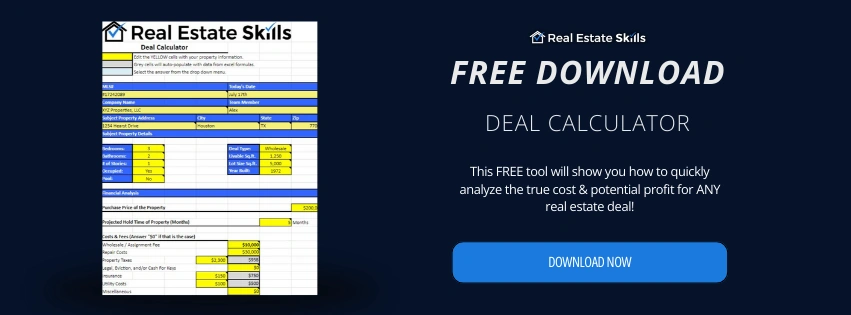
The calculator above is great for running a quick estimate. When you’re ready to analyze deals seriously, our free Deal Calculator spreadsheet lets you work out your Maximum Allowable Offer, factor in repair costs, and check your numbers on every property before you make an offer. Download it and keep it in your toolkit.
Ready To See How Wholesaling Actually Works?
Reading about wholesale real estate is one thing — watching a deal come together start to finish is another. Our FREE Training walks you through the entire process: how to find discounted properties, lock them up, line up cash buyers, and get paid your assignment fee. It’s the same system thousands of our students have used to close their first deals.
Watch The FREE Training →Wholesaling Real Estate FAQs
📓 From The Field
Results vary, but they’re real: Nathan, a Real Estate Skills student in San Antonio juggling a full-time job, closed his first two wholesale deals for a combined fee of roughly $7,800 — after his earliest attempts fell through because he’d underestimated repairs. His path, modest and hard-won, is far more typical of how beginners actually start than the overnight-success stories. Individual results vary, and there is no guaranteed income in wholesaling.
Final Thoughts on Wholesale Real Estate
Wholesale real estate comes down to a simple idea: you find a discounted property, lock up the right to buy it with a contract, and sell that right to a cash buyer for a fee — without ever owning the house. Understand that, and you understand why so many people start their real estate careers here. It’s the lowest-capital, lowest-risk way to learn how deals actually work.
But “low risk” isn’t “no work.” The wholesalers who succeed are the ones who put in the reps — learning to find undervalued properties, knowing what they’re worth, building relationships with cash buyers, and staying honest and compliant with the rules in their state. Those skills don’t just make you a better wholesaler; they’re the foundation of nearly every other real estate strategy, from flipping to building a rental portfolio.
And not every deal closes. Sellers get cold feet, buyers flake, numbers don’t work. That’s normal — it’s the part most people don’t talk about. The ones who make it through are the ones who treat each setback as information, tighten their process, and keep going. If you’re willing to do that, wholesaling is one of the most accessible on-ramps into real estate there is.
Take The Next Step Toward Your First Deal
You now know what wholesale real estate is, how a deal comes together, and what it takes to do it legally and profitably. The fastest way to turn that understanding into action is to see the full system in motion. Our FREE Training breaks down exactly how to get started — watch it today and take the first real step toward closing your first wholesale deal.
Watch The FREE Training →
About The Author
Founder & CEO, Real Estate Skills
Alex Martinez is the Founder and CEO of Real Estate Skills. With more than a decade of investing experience and 33+ residential properties acquired, he has personally wholesaled and flipped houses across the country. Through Real Estate Skills, Alex and his team have helped thousands of students learn how to find deals, use the right contracts, and close profitable real estate transactions.
Real Estate Skills is not a law firm, and the information in this article is provided for educational purposes only — it does not constitute legal, tax, or financial advice. Wholesale real estate laws and requirements vary by state and change over time. Real estate investing carries risk, and past results do not guarantee future outcomes. Always consult a licensed real estate attorney and your own tax and financial advisors before entering into any contract or transaction.

👉FREE Training
How To Consistently Wholesale, Flip Houses, & Invest In Rental Properties From The MLS
(Without Spending $1 On Marketing)

Alex Martinez, the founder of Real Estate Skills, is known for his strong, practical expertise in real estate, starting from a beginner with no family connections in the industry to acquiring over 55 real estate deals, including wholesale and flips, within his first year.
He has dedicated his career to providing cutting-edge education and resources for real estate professionals. He emphasizes the importance of self-taught knowledge through mentors, books, and hands-on experience.
His journey from earning a modest income to becoming a successful real estate entrepreneur and educator showcases his expertise and dedication to the field.

Ryan Zomorodi, co-founder and COO of Real Estate Skills, leverages his experience from a diverse background in real estate investment, construction management, and entrepreneurship to provide comprehensive education in the real estate sector.
His expertise is rooted in hands-on experience, extensive industry knowledge, and a commitment to empowering others through education.
Ryan's journey reflects a blend of practical experience and entrepreneurial success, contributing to his role in developing a platform that educates and supports aspiring real estate professionals.
Read Ryan's Full Bio >>
